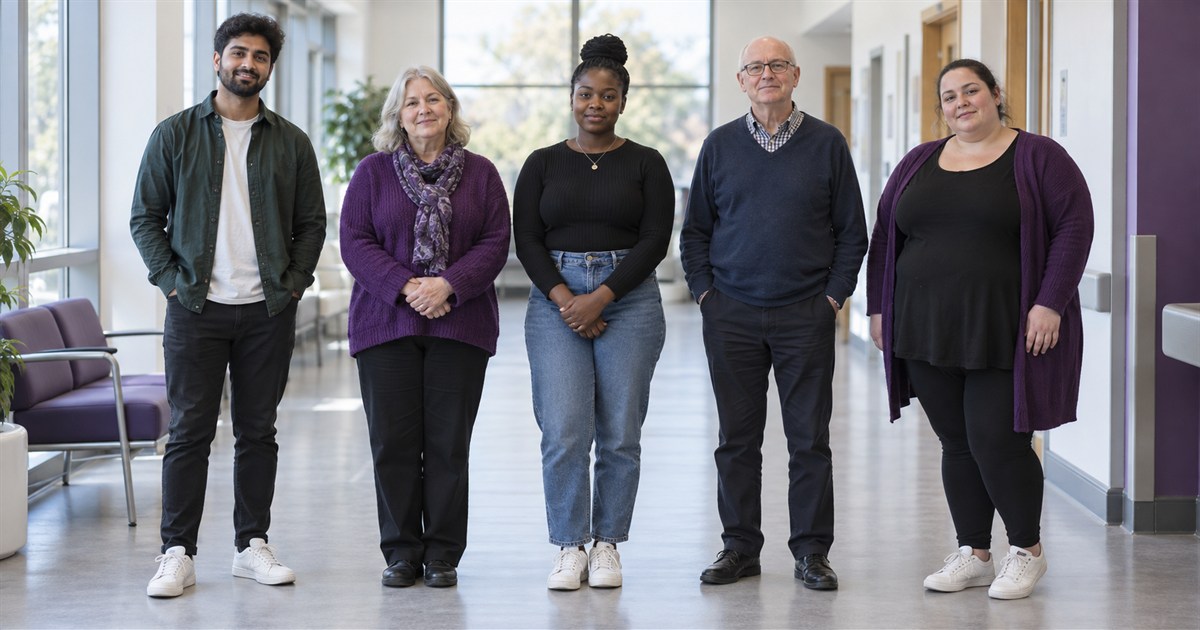
If you’ve ever looked at a weight loss trial and self-qualified yourself out of contention, you’re not alone.
A lot of people assume obesity clinical trials are only for one “type” of person. Common misconceptions are that trials usually look for someone at a very specific weight, with a very specific health profile, who’s ready to start from scratch.
In reality, that’s not how obesity looks. And it’s not how good weight-loss research is either.
Obesity is a spectrum. People sit at different BMIs. They have different health backgrounds. Some are “early” in their weight journey, while others have been dealing with obesity for years. Some have weight-related conditions like high blood pressure or prediabetes. Others don’t. Some people have tried GLP-1 medications. Others haven’t. You get the point.
Clinical trials need that mix, not just for box-ticking or to make things unnecessarily complicated. It’s actually because that’s how we learn what actually helps real people safely across the range of situations in which obesity shows up.
“Different stages” doesn’t mean “more or less deserving”
Let’s get this out of the way early: when research teams talk about “stages” of obesity, they’re not making a moral judgement. They’re describing different starting points because those starting points can change how treatments work, and what “safe” looks like.
Sometimes “stage” means BMI range (for example, people with a BMI above a certain threshold). In other circumstances, it means whether someone has weight-related health issues. It can also be related to medication history, previous weight loss attempts, or whether someone has had bariatric surgery.
And increasingly, it’s also a recognition that BMI alone isn’t the full story, which is why clinical frameworks are starting to look beyond BMI and include things like body fat distribution and whether excess body fat is already affecting health and daily function.
So “stage” is really just a shorthand for: what’s true about your body and health right now, and what question is the study trying to answer?
Why trials need a mix of participants
Weight-loss treatments don’t work the same way for everyone. That’s not a flaw in research; it’s reality. And if trials only recruited one narrow group, we’d end up with results that sound impressive on paper but don’t translate well into day-to-day healthcare decisions.
Here’s why recruiting people at different stages matters so much.
1) It makes the results useful in the real world
If a treatment has only been studied in a narrow slice of people (say, a single BMI bracket with very few co-existing conditions) it becomes harder to answer the questions most people care about:
- Will it work for someone like me?
- What if I have high blood pressure? Or insulin resistance? Or sleep apnoea?
- What if I’m already on medication?
- What does “success” look like across different starting points?
One of the reasons researchers push for broader, more representative recruitment is that trials should help guide real clinical care. It’s not valuable or progressive to just prove something in an idealised setting. Discussions about body size diversity in trials make this point clearly: if higher-BMI individuals are systematically underrepresented, the evidence base becomes less informative for the very population most affected.
2) It helps researchers understand who benefits most, and why
In obesity research, response varies. Some people lose more weight. Some people lose less. Some feel huge appetite changes quickly; others don’t. Side effects differ too.
That doesn’t mean the treatment is “good” for one person and “bad” for another. It often indicates that underlying factors are shaping responses, such as baseline metabolic health, hormones, sleep patterns, stress physiology, medication interactions, and a history of weight cycling.
When trials include people at different stages, researchers can explore patterns like:
- whether a treatment works differently at different BMI ranges
- whether certain co-existing conditions change outcomes
- which monitoring approaches make participation safer and more sustainable over time
That’s not just academic. It directly affects how future care is designed.
3) It improves safety, not just outcomes
Safety isn’t one-size-fits-all either.
For example, a trial may need participants across a range of BMIs because dosing, tolerability, and safety signals can vary with body size and health background. The point is to understand risk properly so future treatments are prescribed and monitored responsibly.
In other words, inclusive recruitment isn’t “looser standards.” It’s better science.
4) It prevents “blind spots” in obesity research
Obesity research is moving fast, and there are no signs of it slowing down. IQVIA’s analysis of the obesity trial landscape highlights just how rapidly research activity has grown in recent years.
When an area of medicine grows quickly, the risk is that the evidence base expands unevenly: strong data in one subgroup, limited data elsewhere.
Recruiting people at different stages helps prevent those blind spots by building a more complete picture of how treatments behave across the broader population.
So why do some trials still have strict criteria?
This is the part that can feel frustrating: you’ll often hear that trials “need diversity,” and then you’ll come across a study that feels extremely selective.
Both things can be true.
Every clinical trial is built around a specific research question. Some questions require a narrower group so researchers can isolate the effect they’re studying. Others aim for broader inclusion so results generalise more widely.
Strict criteria can also be a safety feature. If a study drug has known risks for a certain medical history, or if a condition could make interpretation of results unclear, the protocol may exclude that group. To confirm, that’s not because they’re “not wanted,” but because the trial has to protect participants and deliver reliable answers.
A good study team should be transparent about this. If you don’t qualify, you should be told why (in plain English), and what might change in future.
What this looks like in practice
Here are a few examples of how “different stages” can matter, without turning this into a medical lecture.
Imagine someone who is in the “earlier” end of obesity, perhaps they’ve gained weight gradually over the last few years. Their BMI is over the obesity threshold, and they’re starting to see health changes (like borderline blood sugar). A trial might be designed specifically to understand early intervention: what helps prevent progression and what monitoring is most useful at that stage.
Now consider someone with a higher BMI and established complications, maybe they have sleep apnoea or high blood pressure. A different trial might be designed to answer questions about safety and outcomes in people with a higher baseline risk, because that’s the group where clinicians most need clarity about trade-offs.
Another thought: someone who has already used a GLP-1 medication and is now thinking, “What next?” Some trials actively recruit people with prior treatment exposure, because understanding switching, stopping, restarting, and long-term maintenance is one of the biggest unanswered questions in obesity care right now.
Different stages, different questions, and that’s exactly why multiple study designs exist.
If you’re wondering “do I count?”
If you take one thing from this article, let it be this: You don’t have to look like the “typical” trial participant to be worth screening.
People often self-exclude because they assume they’re too early, too late, too healthy, too complicated, too busy, or “not the right type.”
But obesity research improves when volunteers reflect reality, and reality includes a huge range of starting points.
That’s also why it’s worth registering interest even if you’re not sure you qualify right now. Many clinics and study teams will keep you in mind for future studies with different criteria.
Taking part should still feel practical and human
It’s easy to talk about “participant recruitment” like people are data points. They’re not.
For a study to be ethical and workable, it has to fit around real life, and participants need to feel supported. This is especially true in studies involving weight, where experiences can be emotionally loaded.
At Panthera, we believe in using modern trial delivery methods (like digital forms and self-service booking) to make participation more accessible, which matters when people are juggling work, health, and family life.
And if you want to see how Panthera frames participation in other therapy areas, our trial pages use the same “what this means for you” approach, including what the trial is, why it exists, and what the participation journey can look like.
A simple next step
If you’re curious, the best next step is usually not overthinking it alone. It’s having a straightforward conversation with a study team.
A well-run obesity clinical trial expects questions. It expects hesitations. It expects people to have different starting points.
And the more transparent the study team is with you upfront, the easier it is to decide whether it fits your life, and whether it’s worth exploring further.