Fatty liver disease is not an alcohol diagnosis
The British Liver Trust, now Liver UK, puts the belief that liver disease is always caused by alcohol at the top of its list of liver myths, and calls it probably the biggest one.
The most common form of fatty liver disease in the UK is not alcohol-related at all. It is linked to metabolism: excess weight, type 2 diabetes, raised blood fats and high blood pressure. Alcohol-related liver disease is a separate condition, and other causes exist too, including autoimmune hepatitis and drug-induced liver injury.
That confusion has a cost. It makes people defensive about a diagnosis they did not cause.
What changed in 2023, and why older articles look different
Most of the material online still uses the old names. In June 2023 a multi-society modified Delphi consensus, run by AASLD, EASL and ALEH with more than 200 panellists and endorsed by around 55 societies worldwide including the British Liver Trust, renamed the whole spectrum. The full statement appeared in the Journal of Hepatology, volume 79, issue 6, December 2023, pages 1542 to 1556.
The terms now in use are:
- SLD, steatotic liver disease, the umbrella term for fat in the liver from any cause
- MASLD, metabolic dysfunction-associated steatotic liver disease, replaces NAFLD
- MASH, metabolic dysfunction-associated steatohepatitis, replaces NASH
- MetALD, a new category for MASLD in people with a higher alcohol intake, defined as 140 to 350 g a week for women and 210 to 420 g a week for men
The conditions did not change, only the words. An article about NASH is describing MASH.
MASLD, MASH and liver scarring
MASLD is fat in the liver cells. MASH is the term for that fat with inflammation and liver cell damage alongside it.
Damage that continues can produce fibrosis, which is scarring. Fibrosis is staged from F0 to F4, where F0 means no scarring and F4 means cirrhosis. A liver with fibrosis can still function, though ongoing damage can carry it further along the scale, and scarring that reaches cirrhosis is permanent.
How many people in the UK are affected
Up to 1 in 3 people in the UK have early-stage MASLD, which the British Liver Trust links to the 63 percent of UK adults who are overweight or living with obesity. Around 12 percent of UK adults have MASH, from work by Morgan and colleagues in the European Journal of Health Economics in 2021.
An estimated 4 in 5 people with MASH in the UK have never been diagnosed.
Nor do you have to look overweight. MASLD tracks closely with excess weight, though type 2 diabetes, dyslipidaemia and high blood pressure occur in people who are not obese.
Fibrosis stage is what predicts outcomes
A Swedish cohort followed for up to 33 years, published by Ekstedt and colleagues in Hepatology in 2015, tested which features of the disease predicted death. The NAFLD activity score, which measures fat and inflammation, did not predict overall mortality. Fibrosis stage did. Stage 3 to 4 fibrosis carried a hazard ratio of 3.3 for disease-specific mortality, with a 95 percent confidence interval of 2.27 to 4.76 and a p value below 0.001.
That is why a liver clinic pays so much attention to scarring.
How UK services look for liver scarring
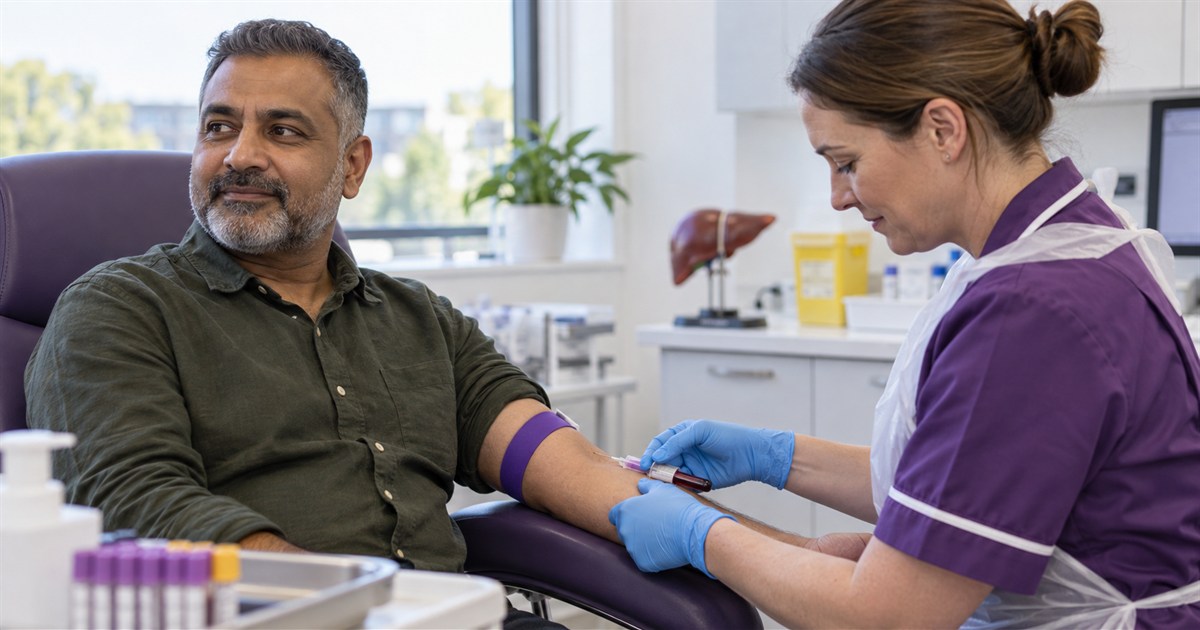
MASH often causes no specific symptoms, even at later stages, so it is usually picked up through blood tests done for another reason.
FIB-4 is calculated from age, AST, ALT and platelet count, and is used as a first-line community triage tool in the NHS. On the published North Bristol NHS Trust pathway:
- under 1.3 in someone under 65 is low risk, with a retest in 3 years
- 1.3 to 3.25 is indeterminate and reflexes to an Enhanced Liver Fibrosis (ELF) test
- above 3.25 is referred to hepatology
NICE guideline NG49, published on 6 July 2016 and last reviewed on 24 October 2024, starts somewhere else. It recommends the ELF test for everyone diagnosed with NAFLD to assess advanced fibrosis, with 10.51 or above prompting hepatology referral and a retest every 3 years in adults otherwise. NG49 does not name FIB-4, and it still sits under the older NAFLD title. A NICE terminology update is in development, project GID-NG10434, with a final scope dated 10 December 2025 and publication expected on 2 December 2026.
You do not need to ask for a named test. Describing your risk factors and any liver results you already have is enough to open the conversation.
Where UK treatment stands in August 2026
There was no licensed medicine in the UK for MASH itself until this year. Two arrived.
The MHRA authorised resmetirom, brand name Rezdiffra, on 3 June 2026 through the International Recognition Procedure, for adults with MASH and stage 2 to 3 fibrosis. It is the first medicine approved in the UK specifically for people with MASH and liver scarring. In the trial data, roughly 26 to 30 percent of people taking resmetirom achieved MASH resolution without worsening of fibrosis at 12 months, against 10 percent on placebo.
In early July 2026 the MHRA also approved semaglutide, brand name Wegovy, for adults with MASH and moderate to advanced fibrosis, under a conditional marketing authorisation separate from its existing weight-management licence.
One caveat matters. As the British Liver Trust sets out in its response to both approvals, these treatments will not be routinely available free on the NHS until they have completed the NICE appraisal process and decisions have been made about NHS funding. Both are in NICE technology appraisal. An MHRA licence is not NHS funding.
What helps whatever happens with medicines
NICE NG49 and the British Liver Trust both put lifestyle change at the centre of managing MASLD and MASH. Losing 5 to 10 percent of body weight can halt or reverse liver damage.
The rest of the package is:
- changes to diet
- regular exercise, covered further in our piece on knee osteoarthritis and weight
- keeping alcohol within low-risk limits, even where alcohol is not the cause
- management of type 2 diabetes
- management of cardiovascular risk factors, some of which are inherited, such as Lp(a)
Frequently asked questions
Is fatty liver disease always caused by alcohol?
No. MASLD and MASH are the forms of fatty liver disease specifically not caused by alcohol, and they are the most common forms in the UK. They are linked to metabolic factors such as excess weight, type 2 diabetes and high blood pressure.
What is the difference between MASLD and MASH?
MASLD is fat in the liver cells. MASH is the stage where inflammation and liver cell damage occur alongside that fat, with a higher chance of progressing to scarring. Both terms come from a 2023 international renaming, in which MASLD replaced NAFLD and MASH replaced NASH.
Can you have MASH if you are not overweight?
Yes. MASLD and MASH are closely linked with excess weight, but the metabolic risk factors involved, including type 2 diabetes, dyslipidaemia and high blood pressure, also occur in people who are not obese. A healthy weight does not rule the condition out.
Is there a treatment for MASH available on the NHS?
Not routinely, as of August 2026. The MHRA authorised resmetirom (Rezdiffra) in June 2026 and semaglutide (Wegovy) for MASH in July 2026, but the British Liver Trust is clear that neither will be routinely available free on the NHS until NICE appraisal is complete and funding decisions have been made.
What is a FIB-4 score?
FIB-4 is a score calculated from your age, AST, ALT and platelet count, all from routine blood tests. The NHS uses it as a first-line community triage tool to sort who is at low risk of advanced liver scarring and who needs further testing.
Can liver damage from MASH be reversed?
Sometimes. Losing 5 to 10 percent of body weight can halt or reverse liver damage, and the liver has real capacity to repair itself. That capacity has limits: severe damage that continues becomes permanent scarring, and at the cirrhosis stage a transplant may be the only remaining option.
About Panthera
Panthera Biopartners is a Site Management Organisation running commercial clinical trials at seven UK clinics, in Glasgow, Enfield, Keele, Preston, Rochdale, Sheffield and York. It does not run first-in-human studies. Our fatty liver disease clinical trials page sets out what taking part involves. Participation is voluntary, you have time to read a Participant Information Sheet and ask questions before consenting, and you can withdraw at any point.
Disclaimer
Not medical advice. This article is general information about MASLD and MASH. Decisions about testing or treatment should be made with a clinician who knows your history.
Conflicts and affiliations. Panthera Biopartners runs clinical trials, including studies relating to fatty liver disease. Whether a study is suitable for you is a question for your own clinician and the study team.